
Mental Health Stigma: How It Hurts and What Helps
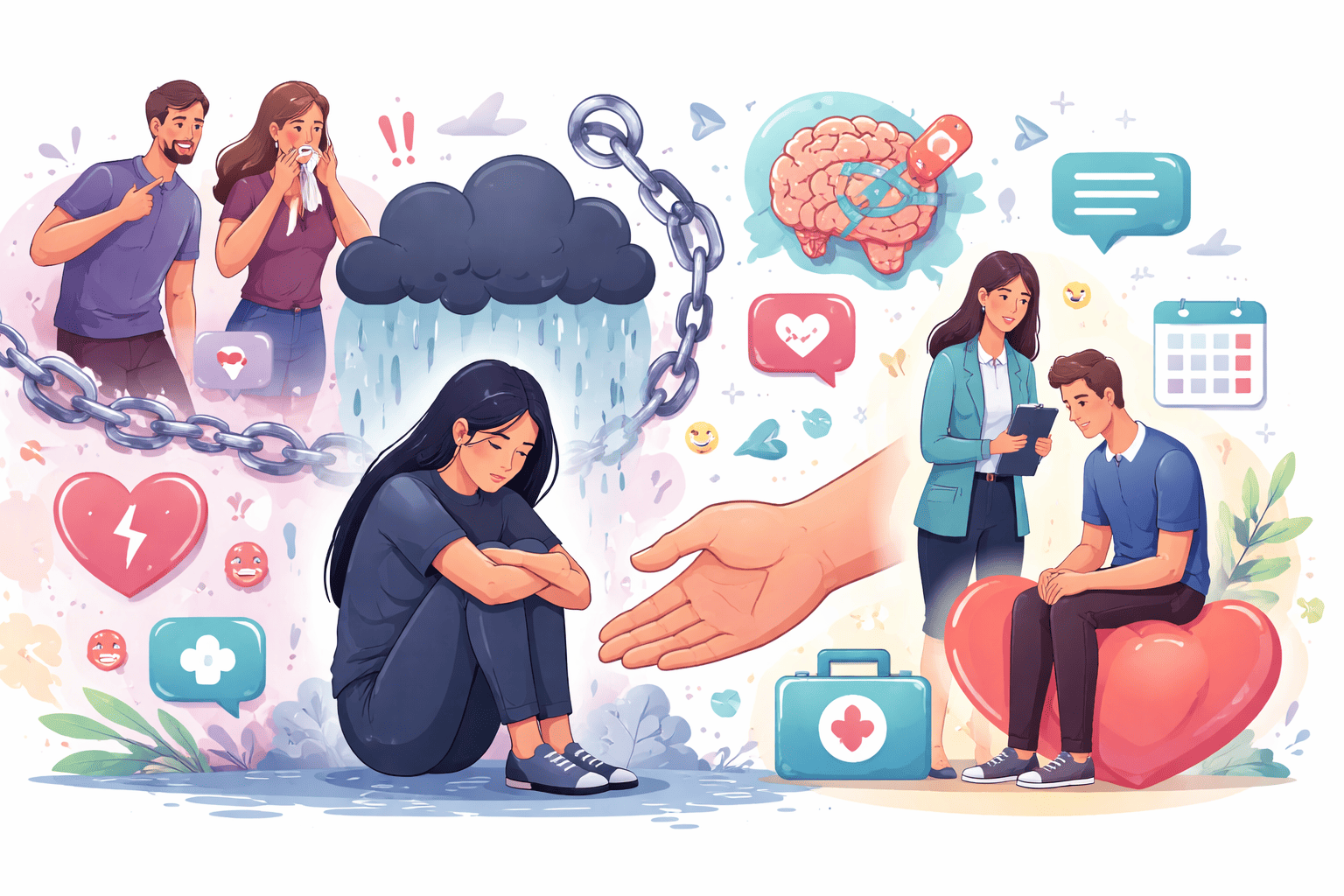
Mental health stigma doesn’t always look like open judgment or cruelty. Often, it’s much quieter than that. It shows up in hesitation, in silence, in the feeling that certain thoughts or emotions should stay hidden. It lives in the pause before someone speaks honestly, and in the habit of telling yourself, I should be able to handle this on my own.
For many people, stigma becomes so familiar that it feels normal. But its effects are far-reaching. It shapes how people relate to themselves, how they connect with others, and how safe they feel expressing what’s happening inside.
Understanding stigma—how it forms and how it affects people—is an important step toward loosening its hold.
What mental health stigma really is
Mental health stigma refers to the negative beliefs and assumptions attached to emotional and psychological struggle. These beliefs often frame distress as weakness, instability, or something to be ashamed of.
Stigma tends to operate on multiple levels at once. There is the social layer—messages absorbed from culture, media, and community. There is the systemic layer—how workplaces, schools, and institutions respond to emotional needs. And then there is the internal layer, where those same messages become self-judgment.
This internalized form of stigma can be especially painful because it doesn’t feel imposed. It feels personal, as though the shame belongs to you rather than to the stories you were taught.
Why stigma exists—and why it lasts
Stigma doesn’t come from a single source. It’s shaped by history, cultural expectations, and long-standing misunderstandings about emotional pain.
Many societies value productivity, independence, and emotional control. While these traits can be useful, they can also create an environment where vulnerability is seen as a liability rather than a human experience. Over time, this leads to unspoken rules about what is acceptable to feel or express.
Language plays a major role here. Phrases that minimize emotions, jokes that equate struggle with weakness, or labels that reduce people to a single experience all reinforce stigma, often without intention.
Media portrayals can deepen this effect by exaggerating or oversimplifying emotional distress. When complexity is flattened into stereotypes, fear and misunderstanding grow.
How stigma affects people in everyday life
Stigma doesn’t stay theoretical. It has very real effects on how people live and relate.
It changes how people treat their own emotions
One of the most common impacts of stigma is self-suppression. People learn, often early in life, that certain feelings are inconvenient, embarrassing, or unsafe to share.
This can lead to patterns such as pushing through exhaustion, dismissing emotional signals, or feeling guilty for needing rest or support. Over time, this disconnect can create a sense of numbness or chronic tension, as the body holds what the voice cannot express.
It affects relationships and connection
Stigma often teaches people to stay guarded. Even in close relationships, there can be a fear of being “too much” or of changing how others see you.
As a result, people may:
Share selectively or vaguely
Avoid difficult conversations
Feel alone even when surrounded by others
This kind of isolation isn’t always visible, but it can be deeply felt.
It influences work, education, and opportunity
Many people worry about how emotional honesty might affect their reputation or prospects. This concern can shape decisions in subtle ways—choosing silence over accommodation, or endurance over honesty.
When emotional struggle is stigmatized, people often feel pressure to perform resilience at all costs. This can lead to burnout, disengagement, and a sense that belonging is conditional.
It affects families and communities
Stigma doesn’t only affect individuals. Families often absorb it too. There may be unspoken agreements to “not talk about certain things” or to keep struggles private to avoid judgment.
While these patterns often come from a desire to protect, they can unintentionally reinforce shame and prevent meaningful support.
It turns into self-stigma
Perhaps the most enduring impact of stigma is when it becomes internal. Self-stigma can sound like a quiet inner voice saying:
“I shouldn’t feel this way.”
“Other people handle this better than I do.”
“If I were stronger, this wouldn’t be happening.”
These beliefs don’t arise because they’re true. They arise because the nervous system has learned that visibility doesn’t always feel safe.
Who stigma tends to affect most
Stigma is shaped by context. Cultural norms, gender expectations, and social roles all influence how emotional experiences are interpreted.
In some environments, emotional expression is discouraged or seen as a lack of discipline. In others, strength is defined as silence. These messages can be especially powerful when reinforced across generations.
For people who already navigate marginalization, stigma can compound, making emotional openness feel even riskier. Recognizing this broader landscape helps shift stigma out of a personal failing narrative and into a more accurate understanding: a learned response shaped by environment.
What helps reduce stigma
Reducing stigma doesn’t require perfect language or grand gestures. It happens through small, consistent shifts in how people relate—to themselves and to others.
If you’re the one carrying stigma
If stigma has shaped your relationship with your own emotions, the first step is often noticing it with curiosity rather than criticism.
This might look like pausing when shame arises and asking where that belief came from, or allowing yourself to acknowledge an experience without immediately minimizing it.
Support doesn’t require disclosure to everyone. Safety and choice matter. Sometimes the most meaningful shift is internal—offering yourself the understanding you may not have received elsewhere.
If you want to support someone else
Reducing stigma in relationships is less about saying the “right” thing and more about how you listen.
Being present, respectful, and non-judgmental can make a significant difference. Allowing space for someone’s experience without trying to fix or explain it away helps create a sense of safety.
Often, what people need most is to feel believed and not alone.
At a broader level
Communities and workplaces play a powerful role in shaping what feels acceptable. When leaders model honesty, rest, and emotional range, it sends a signal that people don’t have to hide to belong.
Clear communication, flexibility, and respect for boundaries all contribute to environments where stigma has less room to grow.
A trauma-informed coaching perspective on stigma
From a trauma-informed coaching perspective, stigma is not a character flaw. It’s a protective adaptation.
Many people learned, consciously or unconsciously, that expressing certain emotions led to criticism, dismissal, or disconnection. The nervous system adapted by tightening, quieting, or staying alert. These patterns often persist long after the original context has changed.
Coaching support can help people begin to notice these patterns without judgment and gently explore new ways of relating to their inner experience.
For some, this includes working with the body and voice as pathways back to expression. Voice-based and somatic exploration can offer a way to reconnect with sensation and presence without needing to explain or analyze everything.
This kind of work emphasizes pacing, choice, and safety—allowing expression to unfold naturally rather than forcing it.
Moving forward with more compassion
Mental health stigma thrives in silence and misunderstanding. It softens when people are met with curiosity, patience, and respect.
You don’t have to share everything. You don’t have to prove strength through suffering. And you don’t have to accept learned shame as truth.
Stigma is not who you are. It’s something many people learned in order to survive.
And what is learned can change.
How Elisa Monti’s Coaching Relates to Mental Health Stigma
Mental health stigma often lives quietly in the body. It shows up as holding back words, tightening the chest, or feeling unsure whether it’s safe to be fully seen.
Over time, these patterns can shape how people relate to themselves and to others, even when they’re no longer in environments that require hiding.
Elisa Monti’s coaching supports people who have been affected by stigma in subtle, internal ways. Her work centers on helping clients notice how learned beliefs about strength, shame, or emotional expression may be influencing their nervous system and daily choices.
Rather than pushing for disclosure or emotional intensity, her approach emphasizes gentleness, pacing, and respect for personal boundaries.
Through trauma-informed, body-aware coaching, clients are supported in reconnecting with their inner experience in a way that feels safe and grounded.
For those who resonate with voice-based or expressive exploration, Elisa offers space to work with sound, sensation, and presence as tools for rebuilding trust in one’s own expression—without pressure to explain or perform.
This coaching is especially supportive for people who have spent years minimizing themselves, staying quiet to avoid judgment, or carrying the weight of “being fine.” The focus is on restoring a sense of choice, agency, and self-connection, so expression no longer feels like a risk but a possibility.
FAQs
What is mental health stigma?
Mental health stigma refers to negative beliefs and assumptions about emotional or psychological struggle that can lead to shame, judgment, or exclusion.
How does stigma affect people emotionally?
Stigma can lead to self-doubt, emotional suppression, and isolation, making it harder for people to feel safe being honest with themselves or others.
What is self-stigma?
Self-stigma happens when societal judgments are internalized and turned inward, often appearing as harsh self-talk or shame.
Can stigma affect relationships?
Yes. Stigma often makes people withdraw or hide parts of themselves, which can create distance even in close relationships.
How can stigma be reduced in everyday life?
Through compassionate listening, respectful language, and creating spaces where emotional experiences are met without judgment.
Why is stigma so hard to unlearn?
Because it’s often tied to nervous system responses that developed to protect against past experiences of disconnection or harm.
