
Navigating Major Life Transitions
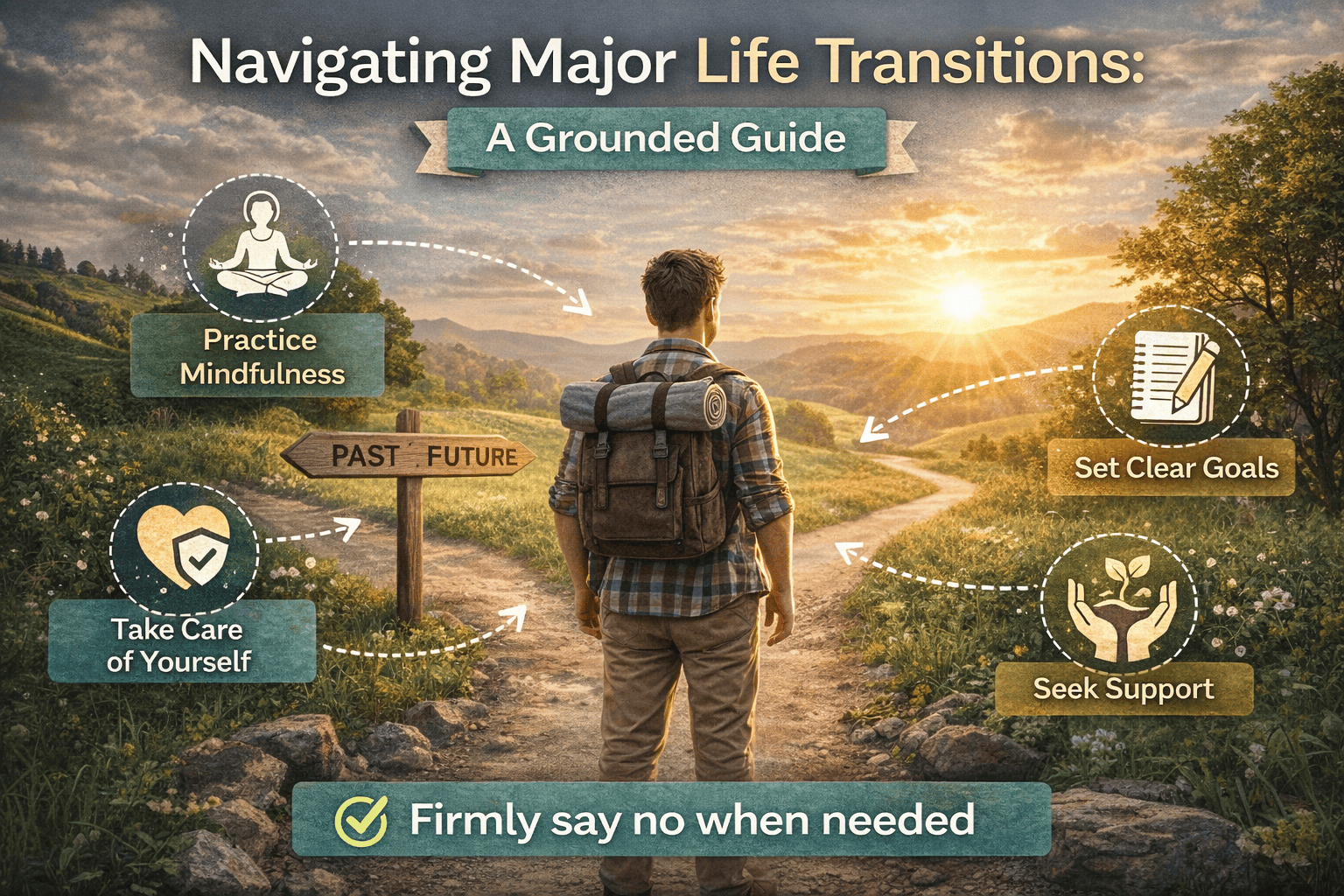
Major life transitions have a way of rearranging everything at once. Not just your schedule or your address or your job title—your inner sense of orientation. The way you know who you are. The way you make decisions. The way you move through your days without thinking too hard about it.
A transition can be something you chose with your whole heart—moving to a new city, starting a new career path, stepping into a new relationship. It can also be something that arrived without permission—loss, separation, a sudden shift in finances, a health change, an unexpected ending. Either way, the experience often shares a common feeling: I’m in between versions of my life, and I don’t know what’s solid right now.
If you’re in a season like this, it doesn’t mean you’re failing. It means you’re human. Transitions are thresholds, and thresholds tend to feel unsteady. In this post, I’ll offer a grounded way to understand what you’re moving through, along with practical tools—especially for the “messy middle,” that tender in-between phase where the old is gone and the new hasn’t fully arrived.
What Counts As A Major Life Transition?
A major life transition is any change that alters your identity, your daily rhythm, or your sense of safety and predictability. Sometimes it’s obvious. Sometimes it’s quieter—like a shift in what you want, what you tolerate, or how you see yourself.
Some common transitions include career changes, relocation, a breakup or divorce, marriage or partnership shifts, loss or grief, financial changes, health-related changes, and life-stage transitions like becoming an empty nester, retiring, or returning to school.
There are also identity transitions that don’t always get named: leaving a long-held role, outgrowing a community, redefining your relationship to family, or realizing you want a life that looks different than what you were taught to pursue.
What makes a transition “major” isn’t what it looks like from the outside. It’s what it disrupts on the inside.
Why Change Can Feel So Intense
There’s a reason even positive change can bring stress. Your nervous system is designed to scan for predictability. When the familiar patterns of life change—where you live, who you talk to daily, what you expect from your mornings—your system notices. It becomes more alert. It looks for cues: Am I safe? What’s next? What do I do now?
In a transition, the answers aren’t always clear. That uncertainty can create a sense of internal agitation: racing thoughts, decision fatigue, emotional swings, disrupted sleep, a tight chest, a sudden urge to control everything, or a desire to disappear.
None of this means you’re “not handling it.” It often means your system is doing its best to adapt.
There’s also a kind of hidden grief that exists in most transitions. Even when something is right, there may be sadness about what you’re leaving behind. Even when an ending is necessary, there may be longing for what you hoped it could have been.
Many transitions ask you to release a version of your future, a role you played, or a story you were living inside.
When grief and uncertainty mix, it can feel confusing. You might wonder why you’re not simply excited, or why you’re not simply relieved. Often, you’re both.
The Three Phases Of Transition
While every journey is unique, most transitions move through a similar arc. When you can name where you are, it gets easier to meet the moment without judging it.
Phase One: The Ending
This is the moment you realize something is over—or changing beyond recognition. Sometimes there is closure, a conversation, a clean timeline. Often there isn’t. The ending phase can include disbelief, bargaining, or the urge to rush ahead so you don’t have to feel what’s here.
The work of this phase is simple but not easy: acknowledging what is ending. Naming what you’re losing. Letting it be real.
Phase Two: The Messy Middle
This is the in-between. The old life doesn’t fully fit anymore, and the new one isn’t established yet. Your identity can feel blurred. Your routines may be disrupted. You may feel strangely untethered, even if life looks “fine” from the outside.
The messy middle is where people often try to force certainty—by overplanning, overworking, overthinking, or making impulsive decisions just to feel movement. It’s also where self-doubt can spike, because you haven’t had enough time to rebuild confidence in the new landscape.
This is the phase we’re going to spend the most time with, because it’s the part most people don’t get guidance for.
Phase Three: The New Beginning
This phase isn’t a dramatic transformation. It’s usually quiet. You begin to make small choices that signal: I live here now. You trust yourself again, not because everything is perfect, but because you’ve gathered enough evidence that you can meet what comes.
The new beginning is built through repetition and presence. Tiny commitments. New rhythms. New identity, not forced—grown.
Core Strategies That Help In Any Transition
Before we go deeper into the messy middle toolkit, here are a few foundational supports that apply across almost every transition.
First: keep a few stabilizing routines. Not to control life, but to offer your system predictability. Second: set small, achievable goals—micro steps that restore agency. Third: lean into connection. Support isn’t just a nice idea; it’s a regulating force. And fourth: make space for mixed feelings. A transition asks for emotional honesty. If you try to outrun your emotions, they tend to get louder.
Now let’s talk about what to do when you’re in the middle of it.
The Messy Middle Toolkit
The messy middle is where you can feel like you’re doing everything “right” and still feel unsettled. This is normal. It’s a phase of reorientation, and reorientation takes time. The goal here is not to eliminate uncertainty. The goal is to build steadiness inside uncertainty.
Here are tools I return to again and again because they are practical, grounding, and deeply supportive.
Create Two Or Three Anchor Routines
When everything is changing, your nervous system benefits from a few simple constants. Anchor routines are not elaborate self-care rituals. They’re small, repeatable stabilizers.
Pick two or three things you can do most days—especially on days when you feel scattered. For example: a consistent wake window, a short walk after lunch, a simple breakfast you can rely on, a five-minute evening reset where you put your space back in order.
You’re not trying to “perfect” your life. You’re giving your body a signal: some things are still steady.
Use The “One Next True Step” Method
In the messy middle, big decisions can feel overwhelming. You may not know the full plan yet. That’s okay. Instead of asking, “What’s the perfect outcome?” ask, “What’s the next true step?”
A true step is something that feels aligned, doable, and honest. It doesn’t have to be dramatic. It might be updating your résumé, visiting a neighborhood you’re considering, scheduling a hard conversation, or simply committing to a consistent bedtime for the next week.
When you take one true step, your mind gets evidence. Evidence builds trust. Trust reduces panic.
Build A Support Circle (Not A Single Person)
Many people try to hold a transition alone—or they lean on one person for everything. A more sustainable approach is a support circle: different types of support from different places.
You might have one person who helps you with practical logistics, one person you can be emotionally messy with, and one person who offers perspective or mentorship. This reduces pressure on any one relationship and helps you feel held in a more balanced way.
Support can also include community spaces that remind you you’re not the only one navigating change. Sometimes just being around others who are growing helps the nervous system soften.
Practice A 3-Minute Reset For Spiral Moments
Spirals happen in the messy middle. A random moment triggers a wave of fear or grief. You start projecting into the future. Your body tenses. You lose your footing.
When this happens, you don’t need a life plan. You need a reset.
Try this:
Name what’s happening: “I’m in uncertainty right now.”
Feel your feet or your hands: something physical and immediate.
Choose one tiny action: water, a few breaths, step outside, text one person, wash your face, stretch your shoulders.
The power here is not in doing it perfectly. It’s in interrupting the belief that you’re powerless. You’re not.
Give Yourself A “Review Date” To Reduce Regret
In transitions, regret can become a daily loop. “Did I make the wrong choice?” “What if I should go back?” “What if I ruin everything?”
One way to reduce this mental churn is to set a review date. Choose a date—two weeks, one month, three months from now—when you will reassess. Until then, you agree to stop re-litigating the decision every day.
This doesn’t mean ignoring red flags. It means giving yourself space to settle and gather information before constantly questioning your reality.
Use A Values Check When You Feel Lost
When your identity feels blurred, values become your compass. A values check doesn’t require you to know the whole future. It helps you choose your next steps with integrity.
Ask yourself:
What am I protecting right now?
What am I moving toward?
What matters more than comfort?
What matters more than approval?
Even one clear answer can create a sense of direction.
Let Mixed Feelings Be True
One of the hardest parts of transitions is believing you should feel only one thing. But real change is layered. You can miss the old life and still know it’s time to move on. You can be excited and terrified. You can feel relief and grief in the same breath.
Making room for mixed feelings is not indulgence. It’s emotional honesty. And emotional honesty is stabilizing, because you’re no longer fighting yourself.
Decision-Making When Everything Feels Unsteady
Transitions can make decision-making feel heavier than usual. If you’re struggling with choices, try simplifying your decision criteria.
Instead of asking “What’s the best option?” ask “What’s the most supportive option for the next season?” The messy middle isn’t about finding the perfect forever. It’s about finding what helps you stabilize, learn, and grow.
Sometimes the most supportive option is the one that gives you more time, more rest, more support, or more clarity—not necessarily the most impressive outcome.
Relationships During Major Life Transitions
Transitions can strain relationships, even healthy ones. When you’re in flux, you may need more support, more patience, or more space. It helps to communicate simply and clearly.
You don’t need long explanations. You can say: “I’m going through a lot of change right now. What would help most is checking in once a week,” or “I don’t need solutions—I just need someone to listen.”
Boundaries also become important. When you’re tender, you may need to limit draining conversations, reduce obligations, or step back from people who can’t meet you with respect. That’s not selfish. That’s stewardship.
How Elisa Monti’s Coaching Supports Major Life Transitions
Major life transitions aren’t only logistical shifts. They are identity shifts. They often bring up older patterns around belonging, safety, self-trust, and voice—especially in the messy middle, where uncertainty can amplify everything.
In Elisa Monti’s coaching, the focus is on supporting you through the internal experience of change: finding steadiness when the ground is moving, reconnecting to what you know is true, and building a rhythm that helps you feel like yourself again—without rushing the process.
Her approach is trauma-informed and body-aware, which means the work includes noticing how transition stress shows up in your system and learning ways to meet it with gentleness instead of force. For clients drawn to voice-based exploration, coaching can also include practices that support expression when words feel stuck—helping you reconnect with your own clarity, presence, and emotional truth in a grounded, paced way.
This is especially powerful in the messy middle, when you don’t need more pressure to “figure it out,” but you do need support that helps you stay connected to yourself while you become who you’re becoming.
A Quiet Conclusion
If you’re in the middle of a major life transition, you don’t need to have the whole map. You only need enough steadiness to take the next step.
Pick two anchor routines. Choose one next true step. Reach for support. Let the mixed feelings be real. And remember: the messy middle is not a mistake. It’s a threshold.
You are not behind. You are in process.
FAQs
What Are The Most Common Major Life Transitions?
Career changes, relocation, relationship shifts, loss, financial changes, health changes, and life-stage or identity shifts are some of the most common transitions.
Why Do I Feel Overwhelmed Even When The Change Is Positive?
Because uncertainty affects the nervous system. Even wanted change disrupts routines, identity, and predictability, which can create stress alongside excitement.
How Long Does It Take To Adjust To A Big Life Change?
There’s no universal timeline. Many people move through adjustment in seasons, not weeks. It helps to focus on stabilizing routines and small steps rather than rushing outcomes.
What Should I Do If I Feel Stuck In The Messy Middle?
Return to basics: anchor routines, one next true step, support, and a simple reset practice for spiral moments. The goal is steadiness, not certainty.
How Can I Create Stability During A Transition?
Stability often comes from a few consistent daily anchors, gentle structure, and clear support—rather than trying to control every outcome.
How Do I Handle Regret After A Major Decision?
Set a review date, gather real information, and reduce daily re-litigating. Regret often softens when your nervous system has time to settle and your life has time to unfold.
How Can Coaching Help During A Life Transition?
Coaching can support clarity, steadiness, and aligned next steps—especially when change brings uncertainty, identity shifts, and emotional overwhelm.
